MagaBox serves you wholeheartedly, we will continue to optimize our products, just for giving you the best product experience.
MagaBox
MagaBox serves you wholeheartedly, we will continue to optimize our products, just for giving you the best product experience.
MagaBox


Explore portable IPTV Boxes for Travel and Hotels solutions designed for travelers and hotel environments in 2026. This comprehensive guide examines compact devices offering home entertainment anywhere—covering essential features like lightweight design, universal power compatibility, easy setup, and multi-language support

Have you ever arrived at a hotel room after a long journey, hoping to unwind with your favorite shows or catch an important sports match, only to find a confusing foreign TV system with channels you don’t recognize? Or perhaps you’ve experienced the frustration of IPTV Boxes for Travel and Hotels packages that charge premium rates for basic content you already access at home? These common travel frustrations have a modern solution that fits in your luggage.
The hotel television experience has remained largely unchanged for decades. Most establishments provide basic cable packages with limited channel selection, often favoring local content over international programming. For business travelers spending weeks away from home or families on extended vacations, this limitation creates an entertainment gap that portable IPTV technology now addresses effectively.
Portable IPTV boxes represent a specialized category of streaming devices optimized for travel scenarios. Unlike standard home IPTV systems, these compact units prioritize lightweight construction, simplified setup procedures, and compatibility with varied network environments encountered during travel. They transform any television screen—whether in a hotel room, vacation rental, or visiting family—into a personalized entertainment center with access to your preferred content.
This guide examines the technical considerations, practical features, and selection criteria for portable IPTV boxes suitable for travelers and hospitality environments. We’ll explore how these devices overcome common travel connectivity challenges, compare specifications that matter for portable use, and identify solutions that deliver reliable performance across different countries and network conditions.
Portable IPTV boxes share fundamental technology with standard home devices but incorporate design modifications addressing travel-specific requirements. These adaptations affect physical construction, power systems, connectivity options, and software configuration.
Size and weight represent the most obvious differences. Home IPTV boxes can utilize larger enclosures to accommodate powerful processors and cooling systems without concern for portability. Portable variants must balance processing capability against compact dimensions that fit easily in luggage without adding significant weight. Modern portable IPTV boxes typically measure less than 4 inches per side and weigh under 200 grams, occupying minimal luggage space.
Power system flexibility distinguishes portable devices from their stationary counterparts. Home systems assume consistent access to standard electrical outlets and can draw higher power for performance. Portable boxes must function across international voltage standards (110V-240V) without requiring voltage converters. Some advanced portable units even support USB power delivery, enabling operation through laptop USB ports or portable battery banks when electrical outlets prove scarce or incompatible.
Network connectivity requirements differ substantially between home and travel environments. Home IPTV boxes connect to familiar, trusted networks with known passwords and security settings. Portable devices must navigate hotel networks with captive portals, public Wi-Fi with authentication pages, and varied security protocols. Software that simplifies connecting to unfamiliar networks becomes essential for practical portable use.
Hotel television systems present numerous limitations that portable IPTV boxes directly address. Understanding these pain points clarifies why travelers increasingly pack these devices alongside laptops and tablets.
Common Hotel TV Problems and IPTV Solutions:
| Hotel TV Challenge | Impact on Guests | Portable IPTV Solution |
| Limited channel selection | Missing preferred content, language barriers | Access to international channels and personal streaming services |
| Expensive pay-per-view | High costs for movies and sports | Unlimited content without per-view charges |
| Disabled HDMI ports | Cannot connect personal devices | IPTV box doesn’t require external device connections |
| Confusing interfaces | Difficulty navigating foreign systems | Familiar interface in preferred language |
| No DVR/recording | Can’t pause or record programs | Time-shift and recording capabilities |
| Restricted smart features | No app installation allowed | Full app ecosystem access |
Language barriers create significant frustration for international travelers. Hotel TV systems typically default to local language interfaces with primarily domestic content. Navigating channel guides, adjusting settings, or searching for specific programs becomes unnecessarily complicated without language familiarity. Portable IPTV boxes operating in the user’s native language eliminate this confusion entirely.
Content continuity represents another challenge portable IPTV addresses. When you’re following a series, tracking sports seasons, or watching ongoing news coverage, travel shouldn’t interrupt access. Traditional hotel TV rarely provides the specific channels or streaming services you use at home. Portable IPTV maintains entertainment continuity regardless of location, allowing you to resume watching exactly where you left off before traveling.
Portable IPTV boxes require specific technical capabilities beyond standard streaming functionality to perform reliably in travel contexts. These requirements address the unique challenges of varied network environments, different electrical systems, and setup simplicity without technical support.
Universal power input (100-240V AC, 50/60Hz) ranks as the most critical hardware specification for international travel. Devices lacking this capability require voltage converters that add bulk, weight, and potential failure points to your travel kit. Quality portable IPTV boxes include switching power supplies that automatically adapt to local voltage standards worldwide.
Compact physical design must not compromise essential connectivity. Despite space constraints, portable boxes should provide HDMI output for connecting to televisions, USB ports for external storage or accessories, and both Wi-Fi and Ethernet network options. The challenge lies in miniaturizing these connections while maintaining durability through repeated packing and unpacking cycles.
Wi-Fi compatibility across varied standards ensures connectivity in different countries. While Wi-Fi protocols remain largely standardized globally, some regions favor certain frequency bands or security methods. Dual-band Wi-Fi (2.4GHz and 5GHz) with support for WPA2 and WPA3 encryption covers the vast majority of hotel and public networks encountered during international travel.
User interface simplification becomes paramount when technical support isn’t available. At home, you might troubleshoot connectivity issues with patience or call your IPTV provider. In a hotel room after a long travel day, you need the device to connect quickly and work immediately. Portable IPTV boxes should offer streamlined setup wizards that guide users through network connection in minutes, not hours.
Physical dimensions and weight determine whether a device qualifies as truly portable or merely transportable. The distinction matters when packing luggage with weight limits or organizing carry-on bags for security screening.
Optimal portable IPTV boxes measure approximately 10cm × 10cm × 2cm (4in × 4in × 0.8in), roughly the size of a smartphone. This compact footprint fits easily in laptop bags, backpack pockets, or suitcase corners without requiring dedicated packing space. Weight should remain under 200 grams (7 ounces)—light enough that you forget it’s in your bag.
Build quality must withstand travel rigors despite compact construction. Plastic enclosures should use impact-resistant materials that tolerate the bumps and pressure of packed luggage. Internal components require secure mounting that prevents damage from movement and vibration during transport. Some manufacturers design portable units with rubberized corners or protective sleeves that absorb impact.
Cable management affects practical portability significantly. A device that requires multiple cables—power adapter, HDMI cable, Ethernet cable, remote control—becomes cumbersome to pack and setup. The best portable IPTV boxes consolidate to essential connections: one power cable and one HDMI cable, with wireless remote or smartphone app control eliminating additional accessories.
Heat dissipation in compact enclosures presents engineering challenges. Smaller cases provide less surface area for heat radiation, yet travel scenarios often place devices in less-than-ideal ventilation conditions—tucked behind hotel TVs or in entertainment centers with limited airflow. Efficient processor designs and passive cooling through metal enclosures manage heat without requiring noisy fans that disturb hotel room quiet.
Hotel network environments differ substantially from residential internet connections, creating specific compatibility requirements for portable IPTV boxes. Understanding these differences helps identify devices capable of reliable connectivity across varied hospitality settings.
Captive portal authentication represents the most common hotel Wi-Fi challenge. Unlike home networks with simple password entry, many hotels redirect new devices to web pages requiring room number entry, terms of service acceptance, or additional authentication. Standard IPTV boxes often fail to navigate these authentication pages properly.
Advanced portable IPTV boxes include web browser functionality specifically for handling captive portals. After connecting to the hotel Wi-Fi network, the device automatically detects authentication requirements and displays the captive portal page for user interaction. Once authenticated, the device remembers the network for subsequent connections during your stay.
MAC address cloning solves connectivity issues at properties that limit device connections. Some hotels allow only a certain number of devices per room or require MAC address registration. Portable IPTV boxes with MAC address cloning can mimic the MAC address of an allowed device (like your laptop), bypassing these restrictions legitimately.
Hotel Network Compatibility Checklist:
| Feature | Importance | Why It Matters |
| Captive portal handling | Critical | Most hotels use authentication pages |
| WPA2/WPA3 encryption support | Critical | Standard hotel security protocols |
| Dual-band Wi-Fi (2.4/5GHz) | High | Different hotels use different bands |
| MAC address cloning | Medium | Overcomes connection limits |
| VPN client support | Medium | Security on public networks |
| Ethernet backup | Medium | Alternative when Wi-Fi fails |
Network speed variability in hotels demands adaptive streaming capabilities. Hotel Wi-Fi quality ranges from excellent fiber connections in premium properties to barely functional systems in budget establishments. Portable IPTV boxes should support adaptive bitrate streaming that automatically adjusts video quality based on available bandwidth, preventing buffering when network speeds fluctuate.
The setup process determines whether your portable IPTV box provides immediate entertainment or becomes a frustrating troubleshooting project in your hotel room. Travel contexts demand simplified configuration that doesn’t require technical expertise or extensive time investment.
Initial setup should complete in under five minutes from unboxing to watching content. This timeline requires thoughtful interface design that guides users through essential steps—language selection, network connection, service activation—without overwhelming them with technical options. Setup wizards that present one clear question at a time, with helpful explanations, achieve this goal effectively.
Network connection should operate through intuitive visual interfaces rather than text-based configuration. Displaying available Wi-Fi networks with signal strength indicators, providing clear password entry fields with show/hide toggles, and offering connection status feedback helps non-technical users establish connectivity successfully.
Pre-configured service integration eliminates complex account setup processes. The ideal scenario involves unboxing the device, connecting to hotel Wi-Fi, and immediately accessing content without entering service credentials or configuring streaming sources. This requires either automatic authentication or extremely simplified login procedures.
Remote control design impacts usability significantly. Complicated remotes with dozens of buttons confuse users and get misplaced in hotel rooms. Simplified remotes with essential navigation controls (directional pad, select, back, home, volume) provide adequate functionality while remaining approachable. Smartphone app control offers an alternative that many travelers prefer, eliminating a separate device to pack and track.
Language support affects international travelers’ ability to navigate interfaces efficiently. Multi-language menus that allow quick language switching accommodate users from different countries without requiring technical knowledge. Visual icons supplement text labels to provide navigation cues that transcend language barriers.
Geographic content restrictions present significant challenges for travelers seeking familiar entertainment abroad. Understanding how portable IPTV boxes address regional content limitations helps select devices that maintain access to preferred programming regardless of location.
IP geolocation determines content availability for most streaming services. When you connect from a foreign country’s IP address, many services either block access entirely or provide different content libraries than your home region offers. This limitation frustrates travelers who want to watch their subscribed content while abroad.
Built-in VPN functionality allows portable IPTV boxes to overcome geographic restrictions by routing connections through servers in your home country. When activated, the VPN makes your connection appear to originate from your home location, granting access to geographically restricted content. Quality implementations include multiple server locations and protocols that balance connection speed with reliability.
DNS configuration offers an alternative approach to accessing geo-restricted content with less impact on connection speeds than VPN. Smart DNS services redirect specific requests related to content authentication while allowing other traffic to flow normally. This selective routing maintains faster streaming speeds compared to full VPN tunneling.
Content source diversity provides another strategy for maintaining access to familiar programming. Portable IPTV boxes that support multiple content sources—IPTV subscriptions, streaming apps, local media playback—offer flexibility when specific sources encounter regional restrictions. If one method fails, alternatives remain available.

Hotel television configurations vary widely across properties, requiring portable IPTV boxes to accommodate different connection scenarios. Understanding common hotel TV setups helps ensure compatibility and successful connection.
HDMI input availability differs by hotel category and renovation status. Modern hotels typically provide at least one accessible HDMI port on room televisions, often labeled for guest devices. Older properties or budget establishments may offer only coaxial cable connections, limiting portable IPTV box compatibility. Premium hotels sometimes disable HDMI ports intentionally to prevent unauthorized device connections.
Before relying entirely on portable IPTV for hotel entertainment, verify HDMI port availability through property reviews or direct inquiry during booking. Many hotel chains now advertise guest HDMI connectivity as an amenity, recognizing travelers’ desire to connect personal devices.
Television input selection poses another practical challenge. Hotel TVs often default to the property’s programming system, requiring manual input switching to display HDMI content. Locating the input or source button varies by TV model—sometimes accessible through remote controls, other times requiring physical buttons on the television itself. Portable IPTV users should familiarize themselves with common input switching procedures across major TV brands.
HDMI-CEC (Consumer Electronics Control) functionality simplifies connection when supported. This protocol allows the IPTV box to control basic TV functions—power on/off, input switching, volume adjustment—through the HDMI connection. Hotels with HDMI-CEC enabled televisions provide more seamless portable IPTV experiences, as the box can automatically switch inputs and control volume without accessing the hotel TV remote.
Resolution and compatibility settings occasionally require adjustment in hotel environments. Some older hotel TVs support only specific resolutions or have quirks regarding supported video formats. Portable IPTV boxes with automatic resolution detection and multiple output format support (480p, 720p, 1080p, 4K) adapt to varied TV capabilities without manual configuration.
Hotels increasingly recognize portable IPTV technology as both a guest amenity and operational tool. Understanding these applications clarifies the technology’s growing role in hospitality environments.
Extended-stay properties represent ideal environments for portable IPTV adoption. Business travelers spending weeks or months at a property expect entertainment options comparable to home. Portable IPTV boxes—whether provided by the hotel or brought by guests—deliver this expectation, improving satisfaction ratings and encouraging repeat bookings.
International hotel chains serving diverse guest populations benefit from portable IPTV’s multi-language capabilities. Rather than configuring room TVs with dozens of language options and international channels, properties can offer portable IPTV boxes with content in guests’ preferred languages. This approach provides superior personalization without complex infrastructure modifications.
Boutique hotels and vacation rentals use portable IPTV as a differentiating amenity. Properties competing against larger chains often seek unique features that justify premium rates. Offering advanced entertainment technology in a simplified, accessible format appeals to tech-savvy travelers who prioritize modern amenities.
Portable IPTV Benefits by Stakeholder:
| User Type | Primary Benefits | Key Features Valued |
| Business Travelers | Familiar content, news access, language continuity | Quick setup, reliable streaming, multi-language |
| Families | Kid-friendly content, multiple viewing options | Parental controls, content variety, easy interface |
| International Guests | Home country content, language comfort | VPN support, international channels, native language UI |
| Extended-Stay Guests | Entertainment continuity, sports following | Recording capability, series tracking, sports packages |
| Hotels/Properties | Guest satisfaction, amenity differentiation | Reliable performance, easy guest support, OEM customization |
Cost reduction represents a significant hotel benefit when deploying portable IPTV systems. Traditional hotel TV systems require expensive infrastructure—headend equipment, in-room set-top boxes, proprietary programming contracts. Portable IPTV boxes eliminate much of this infrastructure while potentially providing superior content variety. Properties can supply portable boxes at a fraction of traditional system costs while offering guests more personalized entertainment.
Guest support simplification occurs when portable IPTV boxes feature intuitive interfaces and reliable connectivity. Hotel staff spend considerable time troubleshooting TV issues and explaining channel guides to guests. Self-explanatory portable IPTV systems reduce support requests, freeing staff for higher-value guest service activities.
Short-term rental properties face unique entertainment challenges that portable IPTV technology addresses effectively. Unlike hotels with dedicated staff and centralized systems, vacation rentals require self-service solutions that guests can operate independently.
Guest turnover frequency in vacation rentals creates setup complexity with traditional streaming devices. Each new guest brings different streaming service subscriptions and preferences. Managing account sign-ins and ensuring previous guests sign out properly becomes administratively burdensome. Portable IPTV boxes that don’t require individual streaming service accounts eliminate this management challenge.
Property differentiation through amenities influences booking decisions on vacation rental platforms. Listings with superior entertainment options—particularly those offering international content for diverse guest populations—receive higher ratings and increased bookings. Portable IPTV systems represent affordable amenity upgrades that significantly enhance property appeal.
Remote property management benefits from standardized, reliable entertainment solutions. Property managers overseeing multiple rentals prefer uniform systems across properties. Portable IPTV boxes that operate identically regardless of location simplify guest instructions and reduce property-specific troubleshooting. Managers can develop single setup guides applicable to all properties, improving operational efficiency.
Guest instructions simplification matters considerably in self-service rental environments. Complicated entertainment systems generate negative reviews when guests struggle with operation. Portable IPTV boxes with visual setup guides, intuitive interfaces, and minimal configuration requirements reduce guest frustration and improve review ratings.
Physical specifications directly impact portability and durability, making these primary selection criteria for travel-focused IPTV boxes. Balancing compact size against adequate performance and durability requires careful specification evaluation.
Dimensions under 12cm × 12cm × 3cm strike an effective balance between portability and functionality. Smaller devices sacrifice connectivity options or processing power, while larger units reduce portability advantages. This size range accommodates necessary components while fitting comfortably in luggage.
Weight below 250 grams ensures the device doesn’t significantly affect luggage weight limits. International airlines increasingly enforce strict baggage weight restrictions, making every gram count. Ultra-light portable IPTV boxes (under 150 grams) provide maximum flexibility for weight-conscious travelers.
Enclosure materials affect both durability and heat dissipation. Plastic enclosures offer lightweight construction and cost advantages but may crack under pressure in packed luggage. Aluminum enclosures provide superior durability and heat dissipation but add weight. Composite materials combining plastic bases with metal tops balance protection, heat management, and weight considerations.
Port protection prevents damage during transport. Exposed HDMI, USB, and power ports can suffer connector damage when items in luggage press against them. Recessed ports or protective covers safeguard connections while adding minimal bulk. Some manufacturers include soft travel pouches that provide additional protection without rigid case weight.
Component quality determines longevity under travel conditions. Budget devices using low-quality solder joints or poorly secured components may fail after moderate transport stress. Reviews highlighting devices that survive extensive travel indicate quality construction worth the potential price premium.
Processing capabilities determine whether a portable IPTV box delivers smooth, buffer-free streaming or frustrating performance issues. Understanding key performance specifications helps identify capable devices despite compact form factors.
Processor speed and core count affect interface responsiveness and video decoding capability. Quad-core processors running at 1.5GHz or higher provide adequate performance for 1080p streaming and responsive menu navigation. 4K streaming demands more powerful hexa-core or octa-core processors with higher clock speeds.
RAM capacity impacts multitasking ability and interface smoothness. Portable IPTV boxes should include minimum 2GB RAM for acceptable performance with modern applications. 4GB RAM provides noticeably better responsiveness when switching between apps or handling complex interfaces with many visual elements.
Video codec support determines which streaming formats the device can handle efficiently. H.264 support represents the baseline for modern streaming, while H.265/HEVC support enables higher quality streams at lower bandwidth—particularly valuable when using potentially slower hotel Wi-Fi. Hardware video decoding for these codecs ensures smooth playback without excessive battery drain on portable power sources.
Portable IPTV Performance Tiers:
| Performance Level | Processor | RAM | Max Resolution | Use Case |
| Basic | Quad-core 1.2GHz | 1-2GB | 1080p@30fps | Budget conscious, HD content sufficient |
| Standard | Quad-core 1.5GHz | 2-4GB | 1080p@60fps | Most travelers, good balance |
| Premium | Hexa/Octa-core 2.0GHz+ | 4GB+ | 4K@60fps | Quality focused, future-proof |
Storage capacity affects app installation and content caching capabilities. While streaming doesn’t require extensive storage, apps, operating system updates, and cached content consume space. Minimum 16GB storage suffices for basic use, while 32GB+ provides comfortable headroom for multiple apps and offline content.
Power source flexibility distinguishes truly portable IPTV boxes from compact devices still tethered to wall outlets. Understanding power options helps select devices matching your travel patterns and power availability scenarios.
AC adapter specifications determine international compatibility. Universal input voltage (100-240V) eliminates voltage converter requirements when traveling internationally. Adapter prong configurations vary by region—North America, Europe, UK, Australia use different standards. Some portable IPTV boxes include interchangeable adapter plugs covering major regions, while others require separate adapter purchase.
USB power delivery support enables operation through alternative power sources. USB-C Power Delivery (USB-PD) at 15W or higher can power many portable IPTV boxes, allowing operation through laptop USB ports, portable battery banks, or USB car chargers. This flexibility proves valuable during transit or in locations with limited electrical outlet access.
Built-in battery integration creates truly cord-free portable operation but adds weight, cost, and charging requirements. Battery-equipped portable IPTV boxes typically provide 3-6 hours of continuous streaming—adequate for flights or outdoor environments without electrical access. However, battery integration increases device weight by 50-100 grams and requires recharging between uses.
Power consumption affects operational costs and portable battery runtime. Efficient portable IPTV boxes consume 5-10 watts during active streaming, while less efficient models may draw 15-20 watts. Lower power consumption extends portable battery runtime and reduces electricity costs during extended hotel stays.
Automatic power management extends battery life through intelligent standby modes. Quality devices enter low-power states during inactivity, reducing consumption to under 1 watt. Quick wake functionality ensures the device responds promptly when needed without maintaining full power consumption during idle periods.

Evaluating portable IPTV box value requires comparing upfront purchase costs against typical hotel entertainment expenses. This analysis reveals the break-even point where portable IPTV becomes economically advantageous.
Hotel in-room entertainment charges vary widely by property category and location. Budget hotels typically offer basic cable at no additional charge, limiting the financial justification for portable IPTV. Mid-range and upscale properties frequently charge $10-30 daily for premium channel packages or pay-per-view content. Business-class hotels in major cities may charge $15-50 for daily premium entertainment access.
Calculate your typical annual hotel entertainment spending to assess potential savings. Business travelers averaging 50 hotel nights annually and spending $15 per night on in-room entertainment incur $750 in annual costs. A $150-250 portable IPTV box achieves cost recovery within 6-12 months while providing superior content variety.
Travel Entertainment Cost Comparison:
| Entertainment Option | Upfront Cost | Per-Trip Cost (7 nights) | Annual Cost (4 trips) | 3-Year Total |
| Hotel Premium TV | $0 | $105-210 | $420-840 | $1,260-2,520 |
| Streaming Service Subscriptions | $0 device | $0 (home subscription) | $180-300 | $540-900 |
| Portable IPTV (monthly subscription) | $80-150 | $35-70 | $420-840 | $1,260-2,520 |
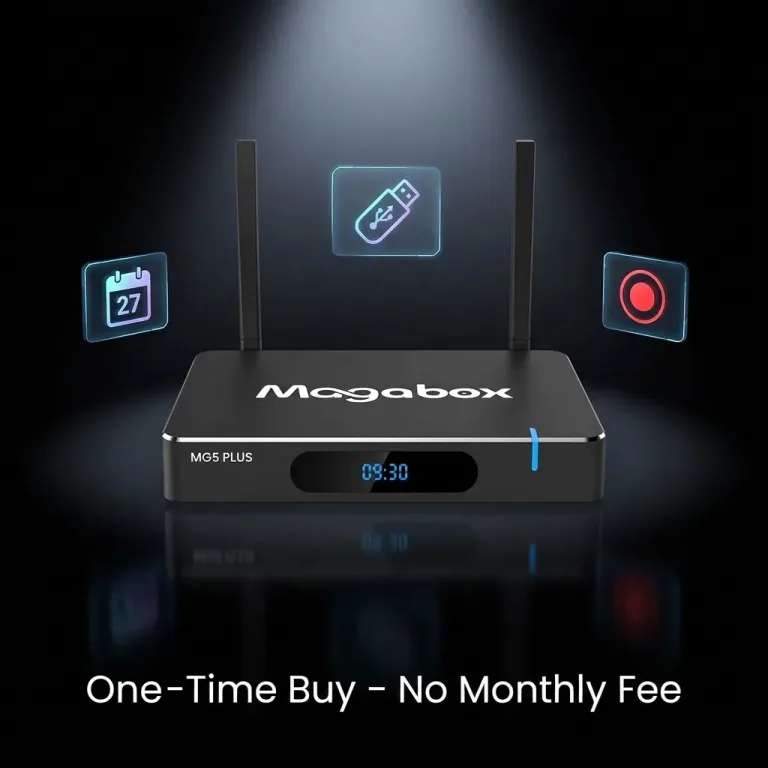
| Portable IPTV (lifetime – Magabox) | $150-250 | $0 | $0 | $150-250 |
Streaming service subscriptions represent an alternative approach but face limitations during travel. While services like Netflix or Hulu require no additional travel costs beyond home subscriptions, they offer limited content compared to comprehensive IPTV solutions. Additionally, geographic content restrictions when traveling internationally limit access to familiar programming.
Lifetime access IPTV boxes eliminate recurring subscription costs, providing exceptional long-term value for frequent travelers. Understanding this model helps appreciate the total cost of ownership advantages.
Traditional IPTV services operate on monthly subscription models ranging from $15-50 depending on channel selection and features. For frequent travelers, these subscriptions represent perpetual expenses without end. A $30 monthly subscription accumulates to $360 annually, $1,080 over three years, and $3,600 over a decade of use.
One-time purchase models invert this cost structure by requiring higher initial investment while eliminating ongoing fees. Magabox exemplifies this approach, offering lifetime content access through single purchase. While upfront costs exceed monthly subscription services, the absence of recurring fees creates substantial long-term savings.
Break-even analysis reveals when one-time purchase models become financially advantageous. Compare total costs over your expected device usage period. For a $200 device with lifetime access versus $30 monthly subscription: Month 1-7 subscription costs less, month 7 reaches break-even, month 8+ lifetime access provides savings that grow larger each month.
Device longevity affects long-term value calculations. A portable IPTV box used for 3-5 years provides excellent return on investment under lifetime access models. Regular travelers might achieve even longer useful life, maximizing savings. However, if you travel rarely or anticipate changing entertainment needs, monthly subscription flexibility might better suit your situation.
OEM customization options add value for businesses deploying portable IPTV at scale. Hotels, corporate housing providers, or travel companies requiring branded solutions benefit from customizable interfaces, pre-loaded content configurations, and specialized functionality. Magabox offers OEM customization allowing businesses to create tailored portable IPTV solutions aligned with brand identity and specific operational requirements.
Successful portable IPTV use begins before departure with preparation steps ensuring smooth operation upon arrival. These advance preparations minimize hotel room troubleshooting and maximize available entertainment time.
Device testing at home verifies functionality before travel. Connect the portable IPTV box to your television, complete initial setup, and confirm streaming performance. This testing identifies potential issues while you have time to address them, rather than discovering problems after arriving at your destination.
Software updates should complete before packing. Manufacturers regularly release firmware updates improving performance, adding features, or addressing security issues. Updating over your home network ensures the device operates with current software. Hotel Wi-Fi may restrict large downloads, preventing updates during travel.
Account credentials and activation codes deserve secure storage accessible during travel. Whether using cloud services, IPTV subscriptions, or VPN access, you’ll need login information to configure the device in your hotel room. Store credentials in password management apps or secure documents synced to your smartphone for easy access.
Packing accessories appropriately prevents setup frustration. Include essential cables—HDMI cable of adequate length, power adapter with appropriate regional plugs, and potentially an Ethernet cable for wired connection backup. A small carrying case organizes these accessories, preventing cable tangling and loss in luggage.
Content pre-loading enables offline entertainment during travel or in locations with unreliable internet. If your portable IPTV box supports local media playback, load favorite movies, TV episodes, or other content to external storage. This preparation provides entertainment options when network connectivity fails or during flights.
Efficient hotel room setup minimizes time between arrival and entertainment access. Following a systematic process ensures successful connection without unnecessary troubleshooting.
Physical connection begins with locating HDMI ports on the hotel television. Check behind or side panels of the TV, as many hotels mount units to walls with ports accessible only from certain angles. Some properties provide HDMI cables connected to wall plates or desktop connection panels for guest convenience.
Power connection may require testing different outlets to find functional ones. Hotels sometimes control outlets through master switches or have specific outlets connected to lighting circuits that disconnect when lights turn off. Identify outlets providing continuous power to prevent unexpected device shutdown.
Network connection through hotel Wi-Fi follows the portable IPTV box’s connection wizard. Select the hotel network from available options, enter passwords if required (often provided at check-in or displayed in rooms), and navigate any captive portal authentication pages. The entire process typically completes in 2-5 minutes with straightforward interfaces.
Input selection on the hotel TV activates the portable IPTV display. Press the input, source, or HDMI button on the TV remote (or physical button on the television) until the IPTV interface appears. Most hotel TVs cycle through available inputs sequentially, requiring multiple button presses to reach HDMI.
Initial configuration completes setup with language selection, time zone setting, and optional features like parental controls. Modern portable IPTV boxes remember these preferences between power cycles, requiring configuration only during first use or after factory resets.
Despite simplified designs, portable IPTV boxes occasionally encounter issues in hotel environments. Understanding common problems and solutions enables quick resolution without technical support.
No video display typically indicates incorrect input selection or cable connection problems. Verify the TV input matches the HDMI port containing the portable IPTV box. Ensure HDMI cable connections are fully seated at both the device and television. Try different HDMI ports on the TV, as some hotels disable specific ports while leaving others accessible.
Wi-Fi connection failures often result from captive portal authentication requirements or network compatibility issues. Open the portable IPTV box’s network settings and verify Wi-Fi network selection. If connection appears established but internet access fails, look for prompts to complete captive portal authentication. Attempting to access any website often triggers authentication page display.
Slow streaming or buffering indicates insufficient bandwidth from hotel Wi-Fi. Try connecting during off-peak hours when fewer guests use the network. If persistent buffering occurs, reduce video quality settings from 4K to 1080p or 720p. Consider switching to wired Ethernet connection if available, as wired connections typically provide more stable performance.
No audio from TV speakers suggests incorrect audio output settings. Check both the portable IPTV box audio settings and TV volume/mute status. Some hotel TVs have separate volume controls for HDMI inputs versus regular TV channels. Ensure TV volume isn’t muted and adjust to appropriate levels.
Device not powering on indicates power supply issues. Verify the power adapter is fully connected to both wall outlet and device. Test the outlet with another device (phone charger) to confirm outlet functionality. Some hotels use master power switches that control multiple outlets—ensure any such switches are in the on position.
For travelers seeking a comprehensive portable IPTV solution without ongoing subscription costs, Magabox offers a compelling proposition combining compact design with lifetime content access. This approach eliminates the recurring fees that make traditional travel entertainment progressively expensive over time.
The Magabox platform delivers extensive international content suitable for diverse traveler needs. Whether accessing news from your home country, following sports leagues during business trips, or providing entertainment for families during vacations, the channel variety addresses varied interests without requiring multiple subscriptions or services.
Physical specifications position Magabox appropriately for travel use. Compact dimensions fit easily in luggage without consuming valuable packing space. Universal power input (100-240V) enables operation worldwide without voltage converters. Simple setup procedures allow non-technical users to establish connectivity quickly in unfamiliar hotel environments.
The lifetime access model with no monthly fees represents Magabox’s most significant value proposition for travelers. Calculate your typical annual hotel entertainment spending and travel frequency. Frequent travelers spending even modest amounts on in-room entertainment recover Magabox costs within months while enjoying superior content variety for years afterward.
Beyond individual travelers, Magabox supports OEM customization for hospitality businesses seeking differentiated guest amenities. Hotels can deploy branded portable IPTV solutions with customized interfaces, pre-configured content appropriate for their guest demographics, and specialized features addressing property-specific requirements. This capability enables boutique hotels and vacation rentals to offer premium entertainment experiences distinguishing them from competitors.
The elimination of monthly fees provides operational simplicity for hospitality deployments. Properties deploying traditional IPTV systems manage ongoing subscription costs, service renewals, and administrative overhead. Lifetime access portable IPTV boxes involve one-time purchase costs followed by maintenance-free operation, simplifying budgeting and reducing long-term entertainment infrastructure expenses.
Selecting the right portable IPTV box for travel requires balancing multiple factors—physical portability, network compatibility, content access, and long-term costs. The explosion of options in this category creates both opportunity and confusion for travelers seeking superior hotel entertainment.
What matters most for your travel entertainment needs? Occasional travelers who prioritize minimal luggage weight might accept limited features for maximum compactness. Frequent business travelers who spend weeks in hotels annually may prioritize performance and content variety over size constraints. Families requiring entertainment for multiple viewers benefit from devices supporting simultaneous streams or kid-friendly content controls.
Physical portability extends beyond just size to encompass power flexibility, network adaptability, and setup simplicity. The technically superior device offering extensive features doesn’t help if it requires complicated configuration you can’t complete after a exhausting travel day. Balance capabilities against practical usability in the environments you actually encounter.
Cost structure deserves careful evaluation for long-term value. Monthly subscription services appear economical initially but accumulate substantial costs over years of regular travel. Lifetime access models like Magabox require higher upfront investment but eliminate recurring fees, providing superior economics for travelers using devices over multiple years.
Consider both current needs and how they might evolve. Travel patterns change—new positions requiring more frequent trips, family growth affecting entertainment preferences, or retirement enabling extended travel. Devices supporting diverse content sources and flexible configuration adapt to changing needs better than locked systems tied to specific services.
Ultimately, the best portable IPTV box for travel balances performance, portability, content access, and cost in a configuration matching your specific travel patterns. By understanding the technical requirements that enable reliable hotel streaming, the features that enhance travel usability, and the total cost implications of different approaches, you can make an informed decision that delivers years of enjoyable travel entertainment.
What entertainment experiences will you enjoy during your next hotel stay? The technology exists to access virtually any content from anywhere in the world. Your choice of portable IPTV box determines whether you’ll enjoy those moments with familiar comfort in unfamiliar places, or settle for limited hotel programming that doesn’t match your preferences.