MagaBox serves you wholeheartedly, we will continue to optimize our products, just for giving you the best product experience.
MagaBox
MagaBox serves you wholeheartedly, we will continue to optimize our products, just for giving you the best product experience.
MagaBox


2026 4K IPTV Video on Demand guide explaining delivery codecs, bandwidth needs, typical library size, sports & movie content availability, hardware requirements and optimization tips. Highlights Magabox as one-time purchase / no monthly fee / OEM customizable solution for stable VOD viewing

Still browsing the same few movies on your current platform every weekend?
In 2026, as on-demand libraries keep growing and rotating, many viewers are quietly asking:
Which IPTV video-on-demand services actually give you thousands of fresh 4K titles, stable playback and reasonable long-term value — without the monthly price creep or sudden title removals?
IPTV video-on-demand (VOD) streams pre-recorded movies, TV series episodes, documentaries and specials over the public internet using adaptive HTTP protocols — mainly HLS (HTTP Live Streaming) and MPEG-DASH.
Both formats break content into short segments (typically 2–10 seconds) and let the player switch quality levels instantly when bandwidth changes. In 2026 the dominant encoding choices are:
Typical bitrate ranges observed in real 2026 IPTV VOD libraries:
| Quality Level | Resolution | Typical Bitrate | Recommended Internet Speed | Visual Characteristics |
| SD | 480p–576p | 1.5–4 Mbps | 8–15 Mbps | Acceptable on small screens / mobile |
| HD 720p | 1280×720 | 3.5–7 Mbps | 15–25 Mbps | Clean for everyday viewing |
| Full HD 1080p | 1920×1080 | 6–12 Mbps | 25–40 Mbps | Sharp on 40–55″ TVs |
| 4K UHD | 3840×2160 | 15–28 Mbps | 40–80 Mbps | Noticeably sharper detail on large screens |
| 4K HDR 10-bit | 3840×2160 | 20–45 Mbps | 60–120 Mbps (wired preferred) | Wider color gamut, deeper contrast |
Audio tracks usually include:
Subtitles are available in 15–30 languages on larger libraries, with forced subtitles for foreign-language content and closed captions for accessibility.
Mid-to-large IPTV VOD libraries in 2026 typically contain:
Content sources include:
Metadata quality varies widely: good providers supply accurate posters, synopses, cast lists, IMDb / Rotten Tomatoes ratings, genre tags, release year and multi-language subtitles.

| Device / Model Family | SoC | RAM / Storage | Wi-Fi / Ethernet | HDMI | Approx. Price (2026) | VOD Strengths & Notes |
| Formuler Z11 Pro Max | Realtek RTD1319C | 4 GB / 32 GB | Wi-Fi 6 / 1 Gbps | 2.1 | $185–215 | Fast library browsing, excellent AV1 support |
| BuzzTV X5 / XRS4900 | Amlogic S905X4 | 4 GB / 32 GB | Wi-Fi 6 / 1 Gbps | 2.1 | $145–175 | Smooth scrubbing in large VOD libraries |
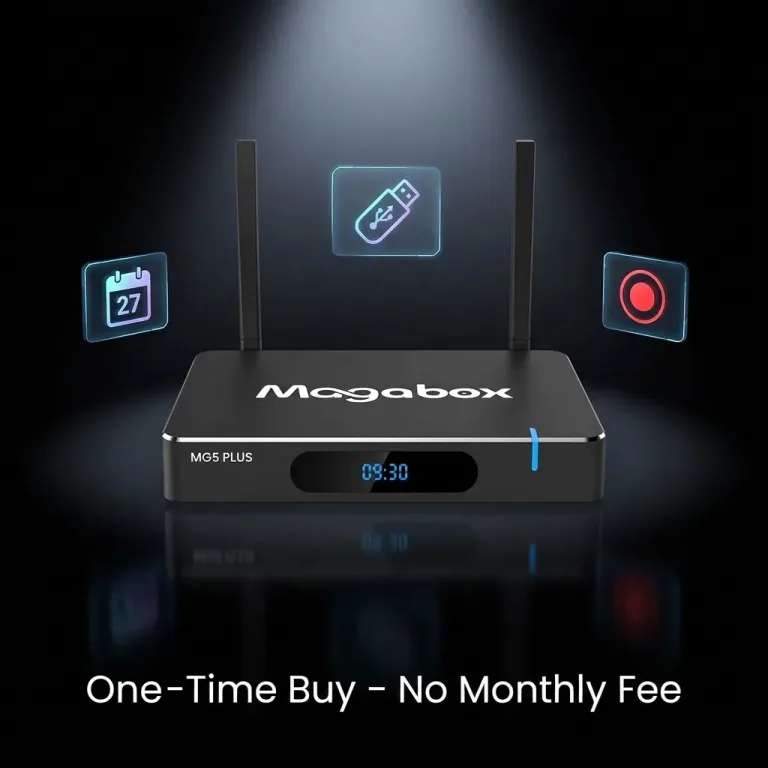
| Magabox (various SKUs) | S905X4 / S928X fam. | 4 GB / 32–64 GB | Wi-Fi 6E / 1–2.5 Gbps | 2.1 | $149–249 | One-time purchase, no monthly fee, OEM customization |
| Nvidia Shield TV Pro | Tegra X1+ | 3 GB / 16 GB + USB | Wi-Fi 6 / 1 Gbps | 2.0 | $199 | Best AI upscaling for non-4K titles |
| Budget Android boxes | Amlogic S905X4 | 4 GB / 64 GB | Wi-Fi 6 / 1 Gbps | 2.1 | $65–95 | Acceptable for HD VOD, struggles at high 4K bitrates |
Magabox is one of the few 2026 models sold on a one-time purchase basis — buy once, receive lifetime access to VOD + live channels (provider-dependent), no monthly fee after initial cost, lifetime firmware support promised, and OEM / white-label versions available for resellers or branded deployments.
Good IPTV VOD plans with large 4K libraries usually cost $20–$50 per month. Over 3–5 years that adds up significantly. Hardware-first models like Magabox — one-time purchase, no monthly fee, OEM customization support — become attractive when the priority is long-term ownership without recurring billing.
If large, stable 4K VOD access without monthly subscriptions matters to you in 2026, which path feels more practical — flexible monthly plans or a single hardware investment?